
Prince William County Active Warrants Explained
“Active” is an agency status label, not a promise that some public page lists every executable warrant. Prince William County publishes no full active-warrant search on the Sheriff’s site. The one official online tool is Virginia’s court-case search. It can surface a case or a warrant event. What it cannot do is show real-time service status across the Sheriff, county police, and town police. For a court or Sheriff-deputy warrant, the Sheriff FAQ gives 703-792-6259. If a police department opened the matter, call that department instead. General District Court can walk through a traffic or misdemeanor docket, though the clerk and the serving agency each answer different questions.
Prince William County Warrant List Search Limits
The lack of a public list is a real local limit, but it does not mean warrant records are missing. The Sheriff keeps court and deputy warrants in its own system, and that internal system is not a name-search page for the public. Police-originated warrants stay with the agency that started the case. Virginia’s statewide court system covers adult criminal, traffic, and selected Circuit information, yet a recent warrant may not appear yet, a protected record may be withheld, and a docket entry may stay silent on whether service is still pending. A blank result is never proof that no process exists. Start with Virginia’s official case system to locate a court and case number. The Sheriff Operations page describes fugitive investigation and pretrial warrant service.
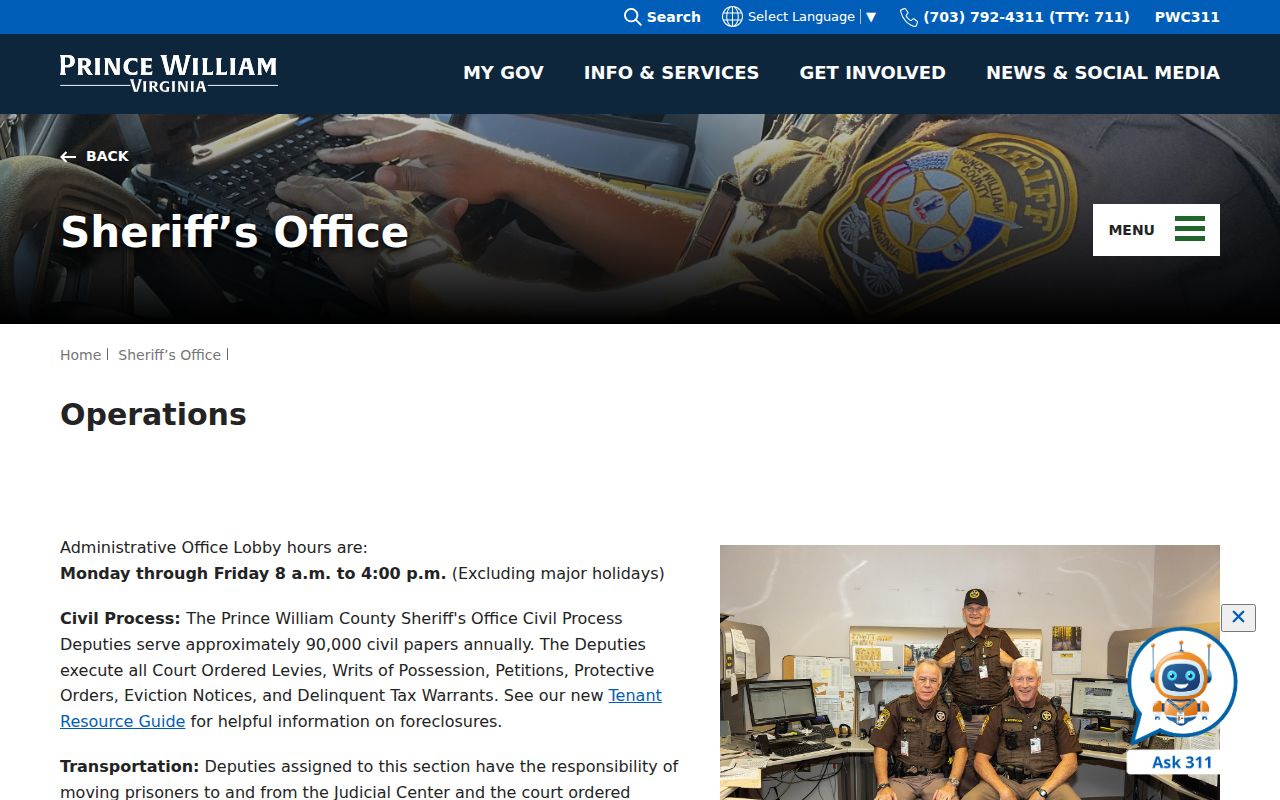
Prince William County’s Sheriff Operations page covers fugitive investigation and pretrial warrant service, not a public warrant roster.
How Prince William County Tracks Active Warrants
Court files and law-enforcement status live in related but separate systems. A magistrate or judge issues the process. The clerk maintains the case file. The assigned police or Sheriff office holds the service information. When service happens, Virginia law calls for a return to a judicial officer. Even then, the public case view may show an event while hiding the agency’s current status code. Prince William County case numbers offer a practical route: C cases belong to Circuit Court, G cases to General District Court, and J cases to JDR. Those letters sort court files, not active status. Use them to reach the right clerk, then ask the law-enforcement office to confirm execution or recall.
Prince William County Warrant Record Fields
A case file may show the charge, issuing court, date, and any later hearing or disposition. Prince William County publishes no status-code glossary or local warrant-number format. So read a “served,” “returned,” “recalled,” or “quashed” entry with its date and the clerk’s explanation. Court records and agency records can update at different times.
| Case number | C, G, or J prefix helps identify the court family. |
|---|---|
| Process type | May identify an arrest warrant, capias, or FTA process. |
| Charge and court | Show the underlying case and the court to contact. |
| Bond field | Terms are case-specific; no countywide schedule was located. |
| Return or status | Confirm the latest action with the court and assigned agency. |
A case result is not a substitute for current service confirmation.
Prince William County Warrant Confirmation Chain
Let the warrant’s origin pick your next call. The Sheriff FAQ says court and Sheriff-deputy warrants sit in the Sheriff’s system. Police-originated criminal warrants belong with the appropriate police department. If the origin is unclear, search the case first and ask the clerk which agency is assigned.
Prince William Police
Police-originated matters
703-792-6517
Use the agency that began the case.
Manassas Police
Independent-city police records
703-257-8000
Separate from county police.
Manassas Park Police
Independent-city police records
703-361-1136
Separate from county police.
Prince William County Case Search Limits
A court-case search answers one question: what case information is available here. A true active-warrant roster would answer a different one, spanning every participating law-enforcement system. Prince William County posts no official public roster, and Virginia’s statewide system is not an OmniBase-style warrant or license-hold search. So never build a conclusion from a name match alone. Check spelling and court selection first. Then ask directly whether a current warrant, capias, or FTA process is active. The issuing clerk can explain the court entry; the Sheriff or the originating police department must confirm its own service record.
Neither a missing online match nor removal from a third-party page proves that a court process has been cleared.
Prince William County: No Warrant Roundups
Prince William County has no Crime Stoppers most-wanted page, no Sheriff roster, and no warrant roundup or amnesty event. That leaves no tip line, reward amount, or update schedule to cite. The gap is the story. No office here runs a roundup, so there is no list to sweep. Drop that phrase. If an agency publishes a public-safety page down the road, it still would not work as a searchable warrant database. The Prince William County Most Wanted List page lays out what official information exists and what does not. One caution stands. Never approach someone over an online claim; follow whatever instructions an official notice actually provides.
Prince William County Warrant FOIA Requests
Paper beats a phone call when you need proof. A Prince William County FOIA request to the right office gets you the document itself. Be specific: name the case, the date, the warrant-service record, or whatever item you need. Say whether you want to inspect it or get a copy. The Sheriff accepts requests by email, mail, fax, phone, or in person, and normally answers within five working days. When more time is required, the office sends a written explanation and may take seven working days extra. Search and copying fees can apply. Public-safety and active-investigation details may be withheld. Criminal case papers sit with the Circuit Clerk instead, so route court-file requests there, not to the Sheriff. The Circuit Court record-access details lay out that separate copy-request process.
Prince William County Warrant Name Match
Start by confirming the match is really you. Pull together the case number, the court, the summons date, and any notice you received, then call the issuing clerk. Ask plainly whether the process is still active, whether a bond has been set, and what appearance, reset, payment, or motion the court wants from you. When the record looks like it grew out of a police investigation, phone that police department as well. A Prince William County warrant search only tells you so much; the clerk's answer is what counts. No county source publishes a universal walk-in surrender time, and none will promise release. Before you show up, a lawyer can call the court and explain the options, whether that means a scheduled hearing, a recall request, or a voluntary surrender. Someone already in custody is a different matter. The Adult Detention Center can confirm current charges, bond, and the next court date, but only while that person remains incarcerated there.
Prince William County Warrant Status Changes
Once something moves in the case, get proof. After a payment, a recall, a new date, or a court appearance, ask for a copy of the order or the receipt, and ask the clerk when the case docket should catch up. Find out whether the Sheriff or the police department needs its own notice too. Prince William County's public search can lag, and it may never show an agency's internal status, so verify with both record holders before trusting an old result. Virginia FOIA does let you file a specific records request. It does not force an agency to build a fresh warrant-status report. The ordinary route is direct confirmation from the office, then a copy request if you need a paper order or a service record on file. Whatever you receive in writing, keep it with the case number.